
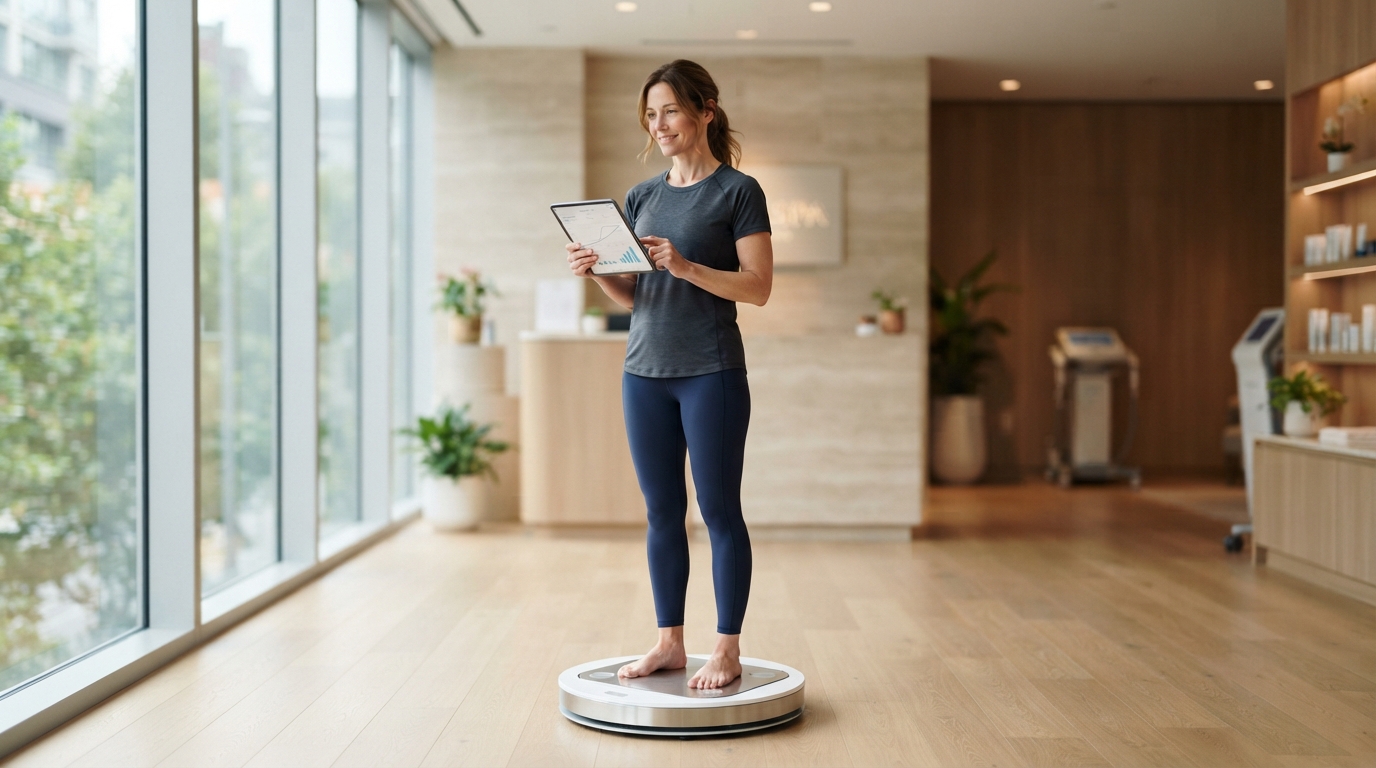
TL;DR: Two people can weigh exactly the same and have completely different bodies underneath. One might be carrying more muscle, the other more visceral fat, and a scale will never tell you which is which. Styku uses infrared 3D scanning to map your actual shape and composition in about 40 seconds, giving you data that weight and BMI simply can't capture. This matters even more if you're losing weight on GLP-1 medications, since a chunk of that "weight loss" can actually be muscle. ASM.D. Aesthetics now offers Styku scans as part of a smarter, non-invasive way to track real progress.
- Why the scale has been lying to you
- How Styku actually works
- The GLP-1 blind spot Styku catches
- Styku vs. the scale vs. BMI vs. DEXA
- What a scan session actually looks like
- Who gets the most out of this
- References
Why the scale has been lying to you
Here's something most people never get told at their annual physical: BMI, the number your doctor calculates from your height and weight, was never designed to measure health. It was developed in the 1830s by a Belgian mathematician trying to describe the "average man" for population statistics, not individual bodies. A muscular 200-pound man and a sedentary 200-pound man with the same height can land on the exact same BMI chart square, despite having wildly different body compositions and health risks. Researchers have been pointing this out for over two decades, and the message still hasn't reached most doctor's offices [1].
The bathroom scale has the same blind spot. It tells you a total number, but it can't tell you if last month's five pounds lost were fat, water, or muscle. That distinction matters a lot more than most people realize, especially once you start actively trying to change your body.
How Styku actually works
Styku uses an infrared 3D scanner, similar in concept to depth-sensing cameras, to capture roughly 500,000 data points across your body in under a minute. You stand on a rotating platform, the scanner builds a full 3D avatar of your body, and software translates that shape data into circumference measurements, body fat percentage, lean mass estimates, and even a visual model you can rotate and compare over time.
Independent validation studies comparing 3D optical scanning to DEXA, which is considered a gold standard for body composition, found that 3D scanning technology tracks changes in body composition closely enough to be useful for monitoring progress over time, even if it's not a diagnostic-grade replacement for DEXA in a clinical research setting [2]. In plain terms: it's accurate enough to actually mean something, and a lot more accessible than scheduling a DEXA scan.
The GLP-1 blind spot Styku catches
This is the part almost nobody talks about. GLP-1 medications like semaglutide and tirzepatide have helped a huge number of people lose significant weight, but clinical research has flagged a real concern: a meaningful portion of that weight loss, in some studies up to 25 to 40 percent of total weight lost, can come from lean muscle mass rather than fat [3]. Losing muscle isn't just a cosmetic issue. Muscle is metabolically active tissue that helps regulate blood sugar, supports joints, and keeps your metabolism from slowing to a crawl.
The problem is that a scale can't distinguish muscle loss from fat loss. It just shows the number going down, which feels like success even when it might not be the kind of success you want. A Styku scan can show segmental lean mass and body fat trends over repeated scans, so if muscle is disappearing faster than fat, you'll actually see it instead of finding out later when you feel weaker or your metabolism stalls.
Styku vs. the scale vs. BMI vs. DEXA
| Method | What it measures | Time | Cost/Access | Limitation |
|---|---|---|---|---|
| Bathroom scale | Total body weight only | Seconds | Free, at home | No composition or shape data |
| BMI | Height-to-weight ratio | Seconds | Free | Doesn't account for muscle vs fat |
| Styku 3D Scan | Body shape, circumferences, estimated body fat and lean mass, posture | ~40 seconds | In-office, non-invasive | Estimate, not diagnostic-grade like DEXA |
| DEXA scan | Precise bone density, fat, and lean mass | 10-20 minutes | Higher cost, less accessible, low-dose radiation | Not practical for frequent monthly tracking |
What a scan session actually looks like
You'll wear form-fitting clothing (think workout gear) and stand still on a small platform while the scanner rotates around you, capturing your shape from every angle. There's no radiation, no compression, no fasting requirement, and no discomfort. Within a couple of minutes you get a full report: circumference measurements at your waist, hips, chest, and limbs, an estimated body fat percentage, a 3D avatar you can compare against future scans, and posture analysis that can flag imbalances you might not notice day to day.
Because it's quick and non-invasive, it's realistic to repeat every few weeks during an active weight loss or fitness phase, which is exactly when trend data matters most. One scan is a snapshot. Three or four scans over a few months is a story.
Who gets the most out of this
Styku is especially useful if you're on a GLP-1 medication and want to protect lean muscle while losing fat, if you've plateaued on the scale despite consistent effort and want to know if your body composition is actually still changing, if you're strength training and want objective proof that muscle is being added even if the scale number barely moves, or if you simply want a clearer starting point before setting a wellness goal instead of guessing based on a number that doesn't tell the whole story.
It also pairs naturally with any body contouring or wellness program, since it gives you an objective before-and-after baseline instead of relying on memory or how your jeans fit.
References
[1] Prentice AM, Jebb SA. Beyond body mass index. Obesity Reviews. 2001;2(3):141-147.
[2] Wong MC, Ng BK, Kennedy SF, et al. Monitoring body composition change for intervention studies with advancing 3D optical imaging technology in comparison to dual-energy X-ray absorptiometry. American Journal of Clinical Nutrition. 2019;110(6):1372-1383.
[3] Sargeant JA, Henson J, King JA, et al. A review of the effects of glucagon-like peptide-1 receptor agonists and dual-acting agonists on body composition. Obesity Reviews. 2019;20(S1):55-71.